
Most of the research U.S. patients do about dental care in Mexico focuses on getting there:
Far fewer patients ask the question that matters just as much:
That question tends to surface at the worst possible time — after treatment, back in the U.S., with a minor concern and no clear idea of who to call.
It doesn't have to work that way.
Follow-up after cross-border dental care isn't something you figure out later. It's something you plan for before you ever sit in the chair. This guide walks through what to ask before leaving the clinic, what records to keep, how communication typically works once you're home, and what to do if you think you need additional care.
Why Follow-Up Deserves as Much Attention as the Appointment
Dental treatment in Mexico can involve a single visit or several, depending on the procedure. But regardless of how many appointments are involved, the relationship with your care doesn't end the moment you cross back over the border.
There are a few reasons follow-up matters more in a cross-border context than it might closer to home:
None of this means something is likely to go wrong. It means that planning for the “after” is part of planning the trip — not an afterthought.
The Questions to Ask Before You Leave the Clinic
The best time to ask about follow-up is before you leave the clinic — while the provider is still in front of you and can answer directly.
Before you walk out, consider asking:
“Is this treatment considered complete, or is more needed?”
Some procedures are finished in a single visit. Others involve a healing period, a temporary restoration, or a planned second appointment. Make sure you understand which situation applies to you.
“What should I watch for during recovery?”
Ask the provider to describe what normal healing looks like, and what would be a reason to reach out.
“How do I contact you if I have a question after I get home?”
Get a specific method — phone, email, messaging app — not just “call the clinic.”
“What if I have a concern once I'm back in the U.S.?”
Understand what the clinic can help with remotely, and what would require an in-person visit — either back at the same clinic or with a local provider.
“Will I need another appointment?”
If so, ask how far in advance it should be scheduled and what it depends on.
“What records will I receive before I leave?”
This sets up the next section — and is one of the easiest things to forget to ask for in the moment.
These are the same kinds of due-diligence questions worth asking before you ever book treatment. Asking them again, specifically about the “after,” closes the loop.
The Documentation You Should Bring Home
Before leaving the clinic, request copies of anything related to your treatment. Documentation is easy to obtain while you're standing in the office — and much harder to track down later, especially across a border.
Consider asking for:
Keep this documentation somewhere you can find it — physically and digitally. A folder, a labeled email, or a scanned copy stored in the cloud all work. The goal isn't to create paperwork for its own sake. It's to make sure that if a question comes up in three weeks, or three months, you're not trying to reconstruct what happened from memory.
How Communication Works After You Return
Communication after treatment typically depends on how the clinic operates, so it's worth clarifying this specifically before you leave — not assuming it will work a certain way.
Generally, patients should understand:
If you worked with a coordination service, this is also where that support becomes useful. Administrative questions — confirming what a charge was for, requesting a copy of a record, clarifying a scheduling detail — often don't require the dentist directly, and having a defined point of contact for exactly that kind of question can prevent small issues from becoming frustrating ones.
What If You Need Additional Care?
Not every case requires additional treatment. But it's worth understanding, ahead of time, what your options would be if something did come up.
Generally, a patient in this situation has a few paths:
Return to the Original Provider
If the concern is related to the specific treatment performed, returning to the same dentist — who has your history and records — is often the most direct option, when practical.
See a Local U.S. Dentist
For patients who live farther from the border, or when timing makes returning to Mexico difficult, a U.S. dentist can often evaluate a concern. This is where your treatment documentation becomes especially useful — it gives the new provider context they wouldn't otherwise have.
Contact Your Coordinator, If You Have One
A coordination service cannot make clinical decisions or diagnose a problem. It can, however, help facilitate communication between you and the treating clinic, or help you understand your documentation and next administrative steps.
None of these paths is inherently “correct.” Which one makes sense depends on the specific situation, the treatment involved, and what the treating dentist advises. The point of thinking about this in advance is simply to avoid the moment of “I don't even know where to start” if a question does come up.
Telling Your U.S. Dentist or Doctor What Happened
If you see a U.S. dentist or physician for any reason after receiving treatment in Mexico — even something unrelated — it's worth mentioning that you had recent dental work done abroad.
This isn't about raising alarm. It's about giving any provider who treats you afterward the full picture, the same way you'd mention a recent surgery or a new medication.
Bring (or be ready to describe):
A U.S. provider who has this information can give you better guidance than one who is missing part of your recent history.
Planning for Multiple Visits
Some treatments — implants, certain restorative work, more complex cases — are planned across more than one appointment, sometimes with weeks or months between them.
If your treatment plan involves multiple visits, ask early:
Understanding this rhythm ahead of time makes it much easier to plan travel, time off work, and — importantly — your expectations. A treatment plan that unfolds over three visits isn't a problem. A treatment plan you didn't know involved three visits can feel like one.
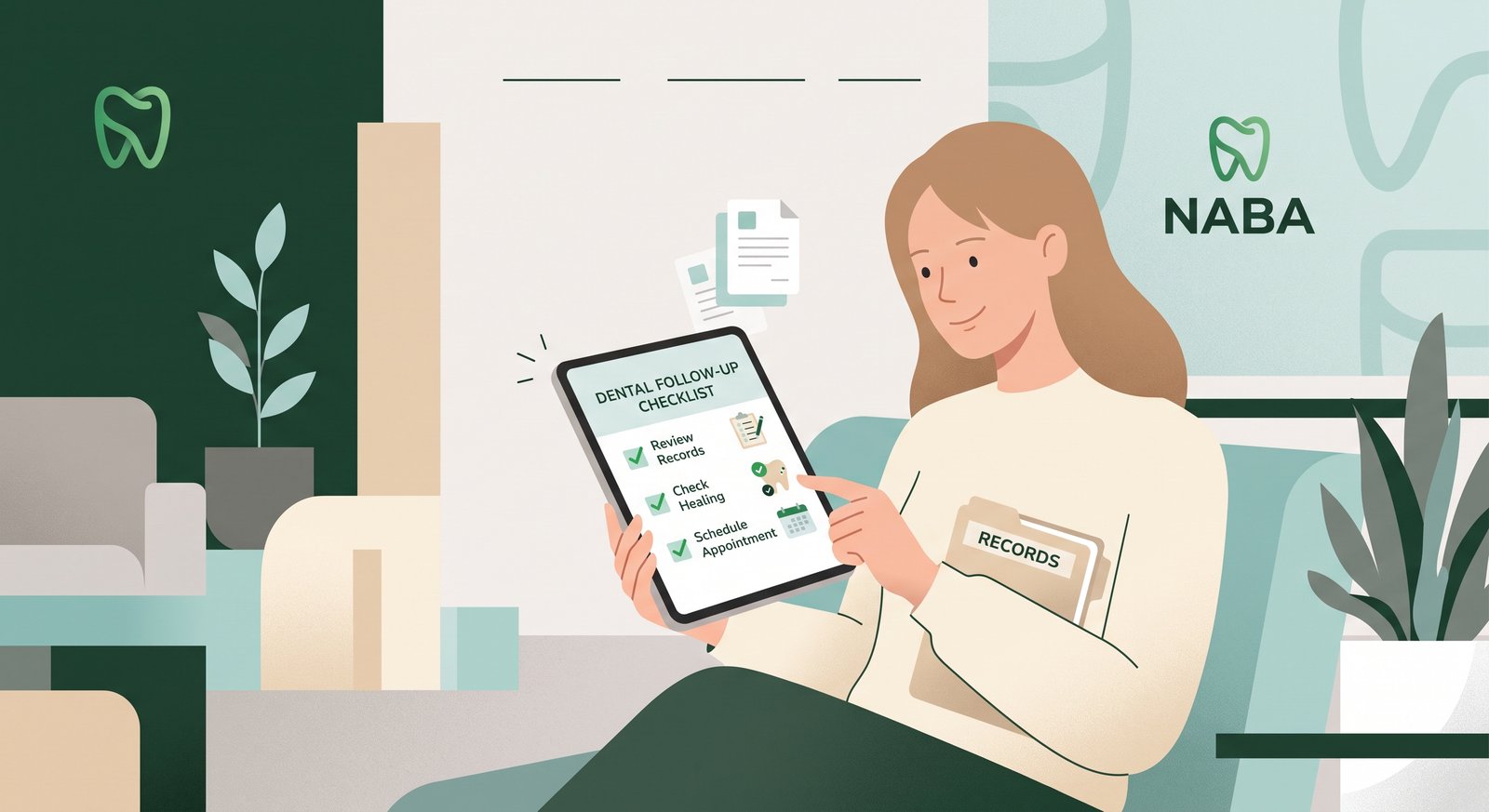
A Simple Post-Treatment Checklist
Before you leave the clinic, run through this list:
Understanding
Documentation
Communication
Planning Ahead
If you can check most of these before you leave, you've already reduced most of the uncertainty that tends to follow patients home.
Where NABA Fits Into Follow-Up
NABA does not provide dental treatment, and NABA does not manage clinical follow-up care. Clinical questions — about healing, complications, or whether additional treatment is needed — are always a conversation between you and the treating dental professional.
What NABA does support is the administrative side of what happens after treatment: helping you understand your documentation, coordinating communication with the clinic when appropriate, and giving patients a defined point of contact for logistical and administrative questions rather than leaving them to figure it out alone.
That distinction matters for the same reason it matters throughout the rest of the journey:
Your dental care is a clinical decision. Your journey around that care — including what happens afterward — can be coordinated.
Final Takeaway
Cross-border dental care doesn't end when the appointment does.
The patients who feel most confident after treatment aren't the ones who assumed everything would be fine. They're the ones who asked a few specific questions before leaving the clinic, kept their documentation, and understood how communication would work if something came up.
None of this requires becoming an expert in dental logistics. It requires a short list of questions, a folder for your records, and a clear answer to one question before you ever leave the clinic:
That single answer does more to reduce post-treatment uncertainty than almost anything else.
Frequently asked questions
What should I do after dental treatment in Mexico?
Before leaving the clinic, confirm whether your treatment is complete, request copies of your records and any prescriptions, and get a clear contact method for follow-up questions. Once home, keep your documentation accessible and mention your recent treatment to any U.S. provider you see afterward.
What records should I keep after dental treatment abroad?
Request a written treatment summary, any X-rays or diagnostic images, your invoice, copies of prescriptions, and written aftercare instructions. Keep both physical and digital copies where you can easily find them.
What happens if I need follow-up care after returning to the U.S.?
Depending on the situation, you may return to the original provider, see a local U.S. dentist, or contact your coordinator for administrative help. Your treatment documentation makes it much easier for any new provider to understand your history.
How do I communicate with a dental clinic in Mexico after I go home?
Ask before you leave what method the clinic uses for post-treatment communication — phone, email, or messaging — and what kind of questions can be addressed remotely versus in person.
Should I tell my U.S. dentist about treatment I received in Mexico?
Yes. Mentioning recent dental treatment abroad, along with any documentation you have, helps any U.S. provider treating you afterward have the full picture.
Does dental treatment in Mexico always require multiple visits?
Not always. Some procedures are completed in a single appointment; others are planned across multiple visits depending on the treatment. Ask your provider directly how many visits your specific treatment plan involves.
What is NABA's role in follow-up care?
NABA does not provide clinical follow-up or make treatment decisions. NABA's role is administrative — helping patients understand their documentation and coordinating communication where appropriate. Clinical follow-up remains between the patient and the treating dental professional.