
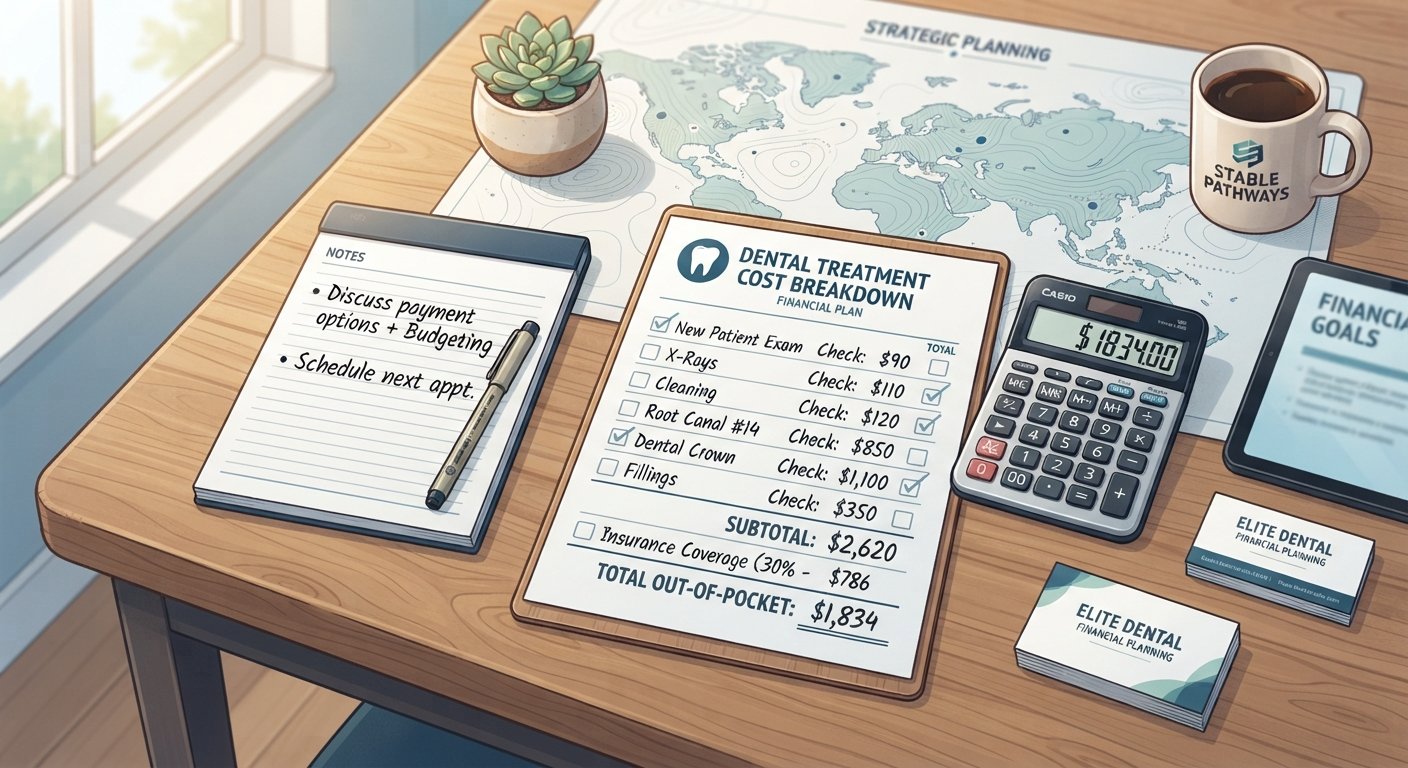
For many U.S. patients, the first question about dental care in Mexico is simple:
How much does it cost?
That question makes sense.
Dental treatment can represent a significant out-of-pocket expense, particularly for patients with limited dental insurance, no dental insurance, or treatment plans involving several procedures. Cost is one of the main reasons Americans research dental care in Mexico.
But there is an important distinction to make before comparing prices:
The price of a dental procedure is not necessarily the same as the total cost of getting that care.
For some U.S. patients, dental care in Mexico may offer an option worth researching. But making a good decision requires looking beyond a single number.
You need to understand the treatment, the provider, what is included in the quote, how many visits may be required, how payment works, and what the trip itself may involve.
The goal is not simply to find the lowest price.
The goal is to understand the complete picture well enough to make an informed decision.
Why Are U.S. Patients Looking at Dental Care in Mexico?
There is no single reason.
For some patients, the issue is affordability.
Dental procedures can become difficult to manage when insurance coverage is limited or when a treatment plan creates substantial out-of-pocket costs.
For others, proximity matters.
Patients who live near the U.S.-Mexico border may be able to access dental care across the border without the kind of long-distance international travel associated with traditional medical tourism.
This is one reason the term cross-border dental care can be useful.
A patient living in a border community may not be planning a "dental vacation." They may simply be considering whether receiving care across the border makes sense for their particular situation.
The combination of cost and proximity can make Mexico an option worth researching.
But affordability and convenience should be viewed as starting points, not as the entire decision.
Is Dental Care in Mexico Actually Cheaper?
For many procedures, dental care in Mexico can cost less than comparable treatment in the United States.
However, that does not mean every procedure will automatically be cheaper, nor does it mean that every patient will experience the same level of savings.
The difference can depend on:
This is why comparing a single advertised treatment price can be misleading.
A lower procedure price may look attractive at first.
But if you need multiple visits, transportation, lodging, additional diagnostic work, or other services, those factors can change the overall calculation.
The better question is not: "How much cheaper is this procedure?"
It is: "What will this entire treatment plan realistically cost me?"
The Difference Between Treatment Price and Total Cost
Imagine that a clinic gives you a quote for a dental procedure.
That quote may represent the cost of the clinical treatment itself.
But your actual expenses could include more than the procedure.
Your total cost may involve several categories:
1. Dental Treatment
This is the core clinical cost.
It may include the procedure itself and whatever the provider has specifically included in the treatment quote.
2. Diagnostic or Additional Services
Depending on the treatment, there may be additional diagnostic work or procedures that need to be considered.
Ask the provider what is included and what is not.
3. Travel
Depending on where you live and where the clinic is located, travel may involve:
For someone living near the border, this may be relatively simple.
For someone traveling from farther away, it can become a much larger part of the overall cost.
4. Lodging
If your treatment requires multiple appointments or an overnight stay, lodging may need to be included in your calculation.
5. Time
Time also has a practical cost.
You may need to take time away from:
This doesn't always appear on a dental quote, but it is part of planning the journey.
6. Follow-Up
Before treatment, ask what happens if you have questions after returning home.
Understand who you should contact and what follow-up may be required.
The point is not to make cross-border dental care sound complicated.
The point is to make sure you are comparing the whole journey, not just one line on a quote.
Why Treatment Complexity Matters
Not all dental treatment is equally simple to compare.
A straightforward procedure may require one visit.
A more complex treatment plan may involve multiple appointments and additional steps.
That means the price you see in an advertisement may not tell you what your individual treatment will ultimately involve.
Before comparing prices, make sure you understand:
Your dentist is responsible for clinical decisions about your care.
NABA's role is not to determine what treatment you need.
NABA's role is to help make the administrative side of the journey easier to understand and coordinate. Clinical decisions remain between the patient and the independent dental provider.
How Many Visits Will You Need?
This is one of the most important questions to ask before comparing costs.
A treatment plan that appears inexpensive may look very different if it requires several separate visits.
Ask the dental provider:
The answer will depend on your individual treatment and the provider's clinical recommendations.
There is no universal number of visits that applies to every patient.
That's why the treatment timeline should be considered together with the cost.
What Should You Ask About a Dental Quote?
Before committing to treatment, don't be afraid to ask for clarity.
Here are several practical questions:
"What exactly is included in this price?"
Ask the clinic to explain what the quoted amount covers.
"Are there additional procedures I should know about?"
Make sure you understand whether the quoted treatment represents the complete proposed plan or only one part of it.
"How many visits will I need?"
This helps you understand the potential travel and time commitment.
"What payment methods are available?"
Understand how and when payment is expected.
"Are there cancellation or scheduling policies?"
Know what happens if your plans change.
"Who should I contact if I have questions?"
This becomes especially important when treatment involves crossing an international border.
"What happens after treatment?"
Ask about follow-up communication and what you should do if you have questions once you return home.
Before you commit, ask about the provider, treatment plan, what is included in the quoted price, number of visits, payment terms, cancellation policies, additional treatment, and who to contact with questions.
How to Compare Two Dental Treatment Options
Let's say you are considering two different options.
Instead of comparing only:
Option A = $X
versus:
Option B = $Y
build a broader comparison.
Consider:
| Category | Option A | Option B |
|---|---|---|
| Treatment | ||
| Provider | ||
| Clinic | ||
| What is included | ||
| Additional procedures | ||
| Number of visits | ||
| Travel | ||
| Lodging | ||
| Payment terms | ||
| Follow-up | ||
| Estimated total |
You may discover that the option with the lower advertised treatment price is not necessarily the option with the lowest overall cost.
More importantly, you may discover that the two options are not actually offering the same treatment plan.
Compare like with like.
Before deciding that one option is cheaper, make sure you understand what each option includes.
What About Dental Insurance?
Insurance adds another layer to the calculation.
If you have dental insurance, don't assume that treatment outside the United States will or will not be covered.
Coverage depends on your specific plan and its terms.
Before making a decision, contact your insurance provider and ask about applicable coverage for treatment outside the United States.
You may also want to ask:
Coverage depends on your individual plan, so confirm the terms directly with your insurer rather than assume coverage. If your plan does cover care abroad, NABA can provide the documentation you need or coordinate the claim with your insurer for you.
A Simple Cost Comparison Checklist
Before committing to cross-border dental care, ask yourself:
Treatment
- [ ] Do I understand the proposed treatment?
- [ ] Do I know which provider will perform it?
- [ ] Do I understand why the treatment is being recommended?
Price
- [ ] Do I know exactly what the quote includes?
- [ ] Have I asked about possible additional treatment?
- [ ] Do I understand the payment process?
Visits
- [ ] Do I know how many visits may be required?
- [ ] Do I understand the expected timeline?
- [ ] Have I considered how many trips may be necessary?
Travel
- [ ] Have I considered transportation?
- [ ] Have I considered lodging if needed?
- [ ] Have I considered time away from work or other responsibilities?
Follow-Up
- [ ] Do I know who to contact with questions?
- [ ] Do I understand what happens after treatment?
- [ ] Have I considered how communication will work after I return home?
If you cannot answer all of these questions yet, that doesn't necessarily mean you should stop.
It may simply mean you need more information before making the decision.
Where Does NABA Fit Into the Cost Conversation?
NABA is not a dental provider.
NABA does not diagnose patients, prescribe treatment, determine clinical care, or guarantee clinical outcomes.
Those decisions remain with the independent dental professional.
NABA's role is on the administrative and coordination side of the journey.
That can include helping coordinate appointments, facilitating communication, organizing documentation, supporting the administrative process, and coordinating payment administration.
This distinction matters.
NABA isn't here to tell you which dental treatment you need.
The purpose is to help make the process around that treatment more organized, transparent, and easier to navigate.
Final Takeaway
Dental care in Mexico can be an option worth researching for some U.S. patients.
Cost may be one of the reasons you are considering it.
But the smartest comparison isn't simply: "How much does this procedure cost?"
It is: "What will this entire treatment journey cost, and do I understand what I'm paying for?"
Look at the provider.
Look at the clinic.
Understand the treatment plan.
Ask what the quote includes.
Consider the number of visits.
Plan for travel.
Understand payment.
Think about follow-up.
And if you have dental insurance, confirm your coverage directly with your insurer.
The goal isn't necessarily to find the lowest number.
The goal is to make a decision with enough information and confidence to understand what you're choosing.
Cross-border dental care does not have to be a leap of faith.
The more informed you are before you commit, the more control you have over the decision.
At NABA, we believe patients deserve that kind of clarity.
Your dental care is a clinical decision between you and your dental provider. Our role is to help make the journey around that care easier to understand and coordinate.
Frequently asked questions
Is dental care in Mexico cheaper than in the United States?
For many procedures, dental care in Mexico can cost less than comparable treatment in the United States. However, savings vary by treatment, provider, clinic, and travel expenses. The best approach is to compare the complete cost rather than relying on a single advertised price.
How much does dental care in Mexico cost?
There is no single price that applies to every patient. The cost depends on the treatment, provider, clinic, complexity of the case, number of visits, and what is included in the treatment plan. Travel and other related expenses may also affect the total cost.
Why can dental care in Mexico cost less?
Prices can differ between countries for many reasons, including differences in operating costs and local market conditions. However, a lower advertised price should not be treated as a guarantee of a specific level of savings. Patients should compare the complete treatment plan and total journey.
What should I ask before accepting a dental quote?
Ask what is included, whether additional procedures may be necessary, how many visits are expected, what payment terms apply, what the cancellation policies are, and who you should contact with questions.
Does dental insurance cover treatment in Mexico?
It depends on your individual insurance plan. Contact your insurance provider directly before making assumptions about coverage or reimbursement.
Do I need to include travel expenses when comparing dental costs?
Yes. If you are traveling for treatment, transportation, lodging, meals, time away from work, and other travel-related expenses may affect your total cost. The importance of these expenses will vary depending on where you live and where the clinic is located.Cross-border dental care refers to receiving dental services across an international border. For U.S. patients who live near Mexico, this can mean traveling to a nearby Mexican city for treatment rather than traveling long distances for medical tourism.
Is the cheapest dental option always the best option?
No. Price is only one factor. Patients should also consider the provider, clinic, proposed treatment, what is included, timeline, payment process, travel requirements, communication, and follow-up.
What is NABA's role?
NABA helps coordinate the administrative side of cross-border dental care. NABA does not diagnose patients, prescribe treatment, provide dental care, or make clinical decisions. Those decisions remain with the independent dental provider.